
Bestselling authors use patterns of rich descriptions (lyrical prose), fresh similes, and witty rants for best writing, and you can too!
By: Grant P. Ferguson
Last Updated: October 22, 2025
Bestselling Author Raymond Chandler
Raymond Chandler lived 70 years (1888-1959), decades of roller-coaster emotions, marked by self-doubt and alcoholism.
Chandler’s life, while fascinating, is not the topic of this post (but it emphasizes you don’t have to be perfect to write 😉). We’ll zero in on a few things that set his work apart from others. You’ll not find tricks or shortcuts, just patterns that take time to adopt and practice for best writing.
Let’s break down a few of Chandler’s writing patterns, highlighting ideas you can use.
Background on this Post
I enjoy reading daily.
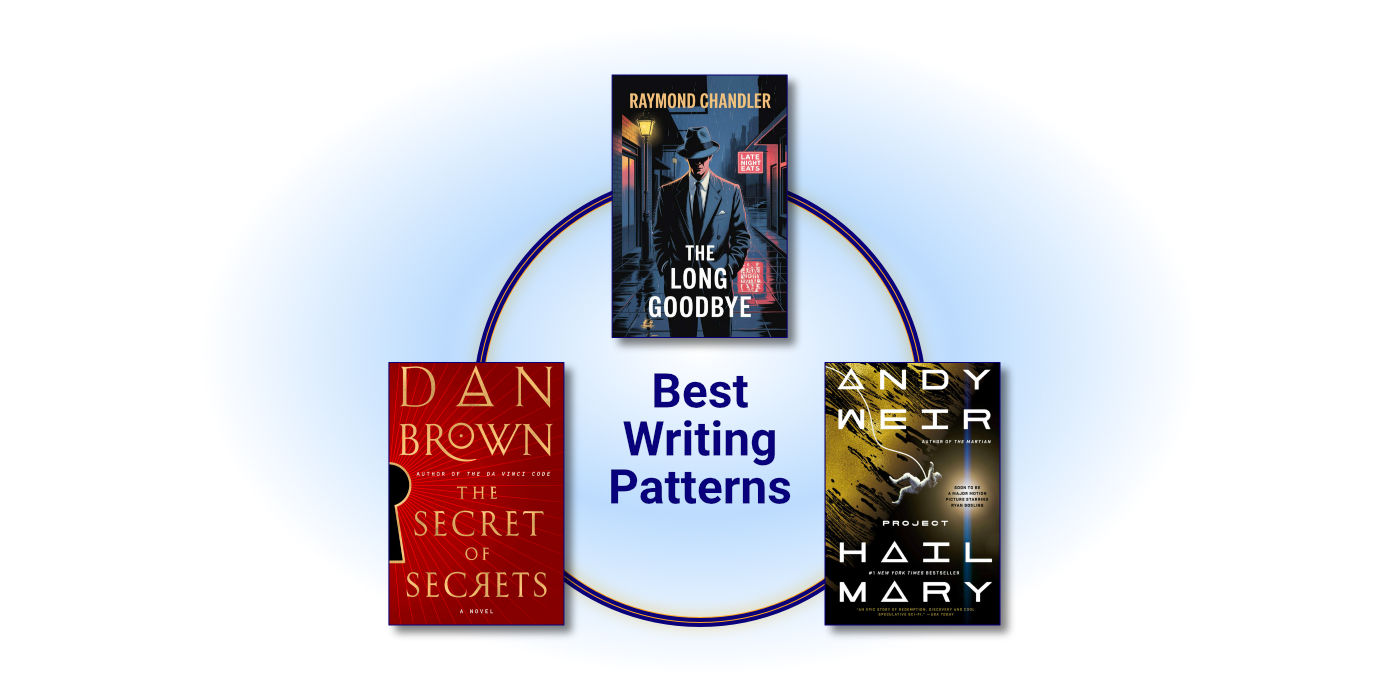
Often, I have two or three books in progress at the same time. That’s by design, allowing me to see the patterns that entertain, inform, and inspire. I’m fascinated by the similar writing patterns used in many bestselling books. For example, I’m currently reading Dan Brown’s The Secret of Secrets (2025), Andy Weir’s Hail Mary (2021), and Raymond Chandler’s The Long Goodbye (1953).
The writing patterns I found worked across three different genres.
- Techno-thriller (Brown)
- Hard Science Fiction (Weir)
- Noir Crime/Hard-boiled Detective (Chandler)
I’ve seen these parallel writing patterns before, and with few exceptions, I believe you can use these models with many popular genres (e.g., romance and mystery).
Top Writers Fulfill Best-writing Expectations
The best writers have figured out how to do three things consistently.
- First, bestselling authors satisfy readers’ requirements for error-free content (e.g., spelling, punctuation, and grammar).
- Next, they fulfill the genre requirements (i.e., conventions and key scenes).
- Then, the top writers focus on ways to surprise and delight target audience.
An Example of Satisfying Readers’ Expectations
Chandler strived to satisfy readers, and in the introduction to Trouble Is My Business, Chandler wrote about what he had figured out.
[About Pulp Magazine Writing]
The emotional basis of the standard detective story was and had always been that murder will out and justice will be done. Its technical basis was the relative insignificance of everything except the final denouement. What led up to that was more or less passagework. The denouement would justify everything. The technical basis of the Black Mask type of story on the other hand was that the scene outranked the plot, in the sense that a good plot was one which made good scenes. The ideal mystery was one you would read if the end was missing. We who tried to write it had the same point of view as the film makers. When I first went to work in Hollywood a very intelligent producer told me that you couldn’t make a successful motion picture from a mystery story, because the whole point was a disclosure that took a few seconds of screen time while the audience was reaching for its hat. He was wrong, but only because he was thinking of the wrong kind of mystery.
[About Hard-boiled Novel Writing]
As to the emotional basis of the hard-boiled story, obviously it does not believe that murder will out and justice will be done—unless some very determined individual makes it his business to see that justice is done. The stories were about the men who made that happen. They were apt to be hard men, and what they did, whether they were called police officers, private detectives or newspaper men, was hard, dangerous work. It was work they could always get. There was plenty of it lying around. There still is. Undoubtedly the stories about them had a fantastic element. Such things happened, but not so rapidly, nor to so closeknit a group of people, nor within so narrow a frame of logic. This was inevitable because the demand was for constant action; if you stopped to think you were lost. When in doubt have a man come through a door with a gun in his hand. This could get to be pretty silly, but somehow it didn’t seem to matter. A writer who is afraid to overreach himself is as useless as a general who is afraid to be wrong.
Source: Raymond Chandler. Trouble Is My Business (pp. 1-2). (Function). Kindle Edition.
Between 1933 and 1939, Chandler learned how to fulfill the editors’ and audiences’ expectations for pulp magazines and novels, and over time, he codified the hard-boiled detective (crime noir) genre.
But then he delivered more — much more than the basics.
Examples of Chandler’s Writing Patterns
In the thirteenth chapter of The Long Goodbye, the chief protagonist, Philip Marlowe, staves off boredom while waiting for a prospective client by observing the people in a hotel bar.
Marlowe describes his impression of the newest arrival.
[Example of a Rich Description with Surprises]
She was slim and quite tall in a white linen tailormade with a black and white polka-dotted scarf around her throat. Her hair was the pale gold of a fairy princess. There was a small hat on it into which the pale gold hair nestled like a bird in its nest. Her eyes were cornflower blue, a rare color, and the lashes were long and almost too pale. She reached the table across the way and was pulling off a white gauntleted glove and the old waiter had the table pulled out in a way no waiter ever will pull a table out for me.* She sat down and slipped the gloves under the strap of her bag and thanked him with a smile so gentle, so exquisitely pure, that he was damn near paralyzed by it. She said something to him in a very low voice. He hurried away, bending forward. There was a guy who really had a mission in life.*
Source: Chandler, Raymond. The Long Goodbye (p. 85). (Function). Kindle Edition.
*The bold text highlights patterns designed to surprise and delight readers.
Chandler then disrupts the expected scene flow with a 500-word rant about blondes and their traits. The rant stops when his prospective client finally shows up.
A Disruptive Pattern
A witty rant is a disruptive pattern, one that takes the reader down an interesting rabbit hole. We’re not sure where the tunnel goes, but the content is so intriguing, we keep going until we emerge on the other side.
In my concurrent novel reading, I noticed that Andy Weir and Dan Brown used similar rich descriptive patterns, and occasionally, disruptive patterns of witty rants.
- Weir riffs on the hard-science, alien creature details, and his emotional state.
- Brown dives into exotic locales, symbol details, and his investigative insights.
All three authors use narrative drive, but that’s a topic for another post.
Simile Patterns that Surprise and Delight
I’ll list more Chandler examples from various stories, focusing on the simile patterns designed to delight readers with surprise descriptions.
Imagine how one of these creative gems could lighten an otherwise dark scene.
- The muzzle of the Luger looked like the mouth of the Second Street tunnel.
- It was a blonde. A blonde to make a bishop kick a hole in a stained-glass window.
- He had a heart as big as one of Mae West’s hips.
- She gave me a smile I could feel in my hip pocket.
- Dead men are heavier than broken hearts.
- The coffee shop smell was strong enough to build a garage on.
- I went back to the seasteps and moved down them as cautiously as a cat on a wet floor.
- She had eyes like strange sins.
- He was crazy as a pair of waltzing mice, but I liked him.
- She looked playful and eager, but not quite sure of herself, like a new kitten in a house where they don’t care much about kittens.
- I felt like an amputated leg.
- She smelled the way the Taj Mahal looks by moonlight.
- He was about as inconspicuous as a tarantula on a slice of angel food.
- California, the department-store state. The most of everything and the best of nothing.
- The girl gave him a look which ought to have stuck at least four inches out of his back.
- “Please don’t get up,” she said in a voice like the stuff they use to line summer clouds with.
The examples above helped balance the dark side of the Chandler style of crime noir.
In Andy Weir’s Hail Mary, the author periodically includes humorous asides and descriptions, almost as if he’s winking at the audience as he and an alien fight impossible odds to save their home planets.
Dan Brown embeds clever similes and descriptions throughout his eight novels.
Find and Use Best Writing Patterns
As you can see from these examples, the descriptions and similes are fresh, but not entirely original.
You can add your unique blend of content and humor to freshen any pattern, especially similes. It’s difficult but doable. Deep-dive thinking, risk-taking creativity, and sleeves-up work can elevate your writing from good to best.
In your reading, look for writing patterns.
- Rich Descriptions
- Fresh Similes
- Witty Rants
Use passages from your reading as models to construct content patterns that set your best writing apart from others.
Leave a Reply
Where do you find models of writing patterns, and what is one of your favorites?
12 responses to “Best Writing Is Hard Work”
I wanted to recommend your blog, but I’m not sure how. Help!
Thanks for asking, Don. Log into WordPress and click on the “👓 Reader” at the top. In the middle of the left-hand column, click on the “👥 Manage Subscriptions” link. That will bring up all the sites you follow via the WordPress Reader. Click on the ones you would like to recommend, and WordPress will take care of the rest. Have a great weekend!
Thank you, Grant.
I love that list of similes, Grant. Similes and metaphors that are so original that they surprise, delight, or make me inhale a sharp breath are my favorites. I try to include them in my writing, and it’s not easy. Worth it, though, when a reader notices them.
Since writing this post, I’ve come across dozens more. Some fantastic patterns from James Scott Bell and Candle Sutton. Even if not noticed consciously, the subconscious gives a little joy-jolt to the brain, a surefire reason for readers to keep turning those pages.
I always enjoy reading about the detail you find in writing. Thanks.
You’re welcome, Jacqui, and I marvel at your detailed research. Thanks for stopping by today.
This is such an interesting post about Chandler’s writing. “Disruptive” pattern, oh, I see!
I like Chekhov’s repetitive pattern in The Darling. It’s a novelette in which he tells a woman’s love story again and again, and her behaviors repeat even though the situations are different.
Very perceptive, Priscilla, and at first glance, these disruptive patterns could be mistaken for “filler.” However, the bestselling authors take us on rides of imagination, and with Weir, that means an education in chemistry and biology. With Brown, we visit exotic places that most will never visit, but he makes us believe we’re there. Chandler delves into many of the beliefs and emotions of his period.
Exciting stuff, and best of all, what writers can conceive, we can achieve!
Thanks for this post, Grant, I enjoyed reading about patterns which I tend to take for granted. I’ll enjoy looking out for them in future. 🙂
Thanks, Laura! I was tempted to list patterns from Brown and Weir, but did not want to spoil the fun. Like an omelet, writers can add their unique creativity, style, and humor to freshen the patterns, creating content recipes that set them apart from others.
Keeping things fun is the best way to get a message across. Well done you, and thanks again. 🙂