
After other priorities, do you struggle to pick up and write where you left off? Restore your writing flow with the Story Spine.
By: Grant P. Ferguson
Last Updated: September 3, 2025
Life’s Priorities Can Wreak Havoc on Writing Flow
This is not a lecture about priorities, but an acknowledgement that life often minimizes your time to write.
When that happens, focus on what you can do to restore your writing flow.
For example, I took time off from writing fiction to revise and publish the third edition of The Trellis Method: Master Story Structure. The update needed to be done, but that one effort cascaded into several and added delays, like updating graphics, tweaking old posts, and creating new Pinterest boards.
My WIP lay fallow for months, and if not for Trellis Method, I would have struggled to reconnect the narrative threads that linked multiple POVs and subplots.
The Story Spine Primes Your Writing-flow Pump
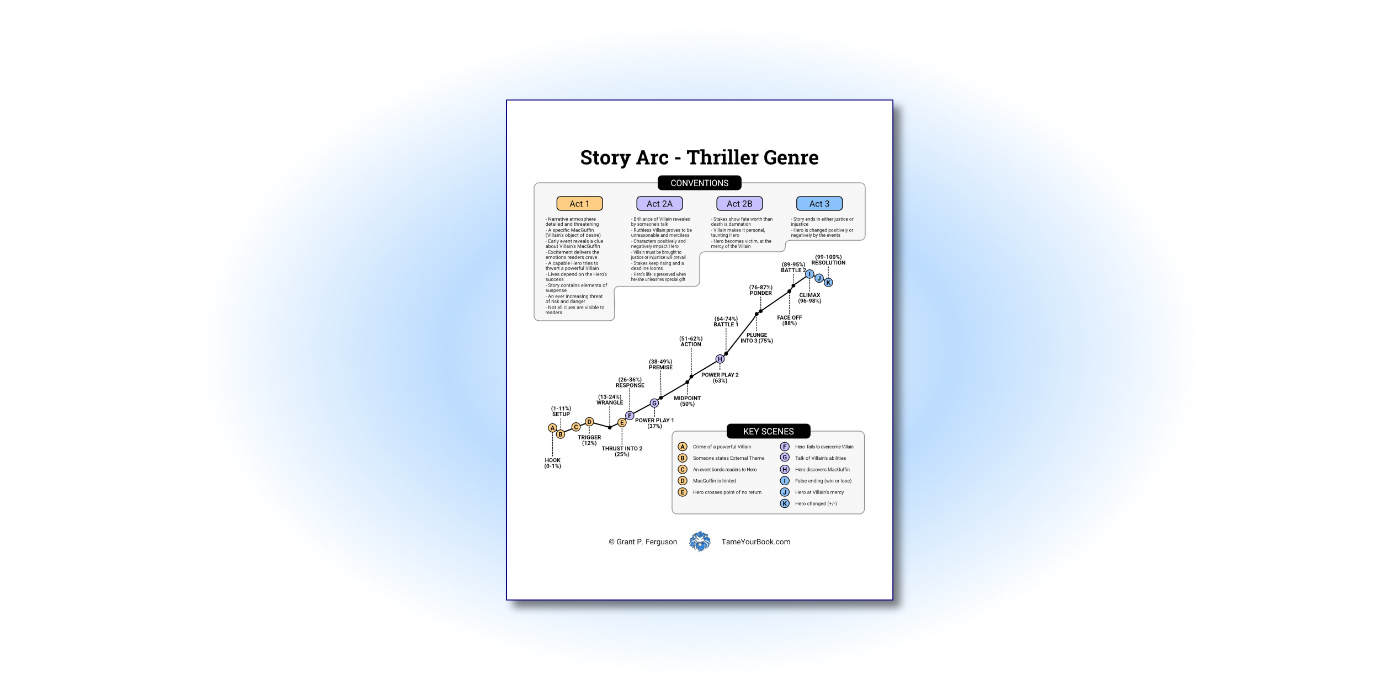
The Story Spine helps you envision your entire story built on solid supporting piers.

Reconnect the Threads of Your Storyline
To reconnect the threads of my storyline, I started with the main plot.
- HOOK—Scene 1: Chicago Crime (Protagonist’s Fiancée Dies)
- TRIGGER—Scene 17: Protagonist’s Decision (Cause for Action)
- SETUP—Scene 18: Protagonist’s Epiphany (Who, What, Where, When, Why)
- THRUST INTO 2—Scene 31: Protagonist’s Catalyst (Move into Act 2A)
- MIDPOINT—Scene 63: Protagonist Understands Need (Mirror Moment)
- PLUNGE IN 3—Scene 85: Protagonist’s All-Is-Lost Moment (Start Act 3)
- CLIMAX (Part A)—Scene 117: Protagonist Prepares (Life or Death Fight)
- CLIMAX (Part B)—Scene 120: Protagonist Applies Lesson (Wins Fight)
- RESOLUTION—Scene 129: Protagonist Transforms (Satisfies Audience)
Note: In this story, the SETUP follows the TRIGGER because I used flashbacks.
As shown in Build a Story Spine, you can refresh your memory of the story threads based on the prompt-based worksheet, guiding you to gather details and outline the core message for target readers.
Review the Story Spine for Each Subplot
In my WIP, I’m amplifying the main plot of the thriller with four subplots.
Note: In this thriller, I’m using multiple (130+) short-in-length scenes with different point-of-view characters for the main and subplots. You may prefer lengthier scenes and fewer point-of-view characters.
To add interest and engage readers, I used subplots and separate point-of-view characters (e.g., protagonist, antagonist, love interest, love rival, mentor). However, multiple POVs and subplots added complexity. Thus, it helped me to label, color-code, and track my subplots. You can do the same using a spreadsheet, sticky notes, or Scrivener.
Here are my labels and color coding for the main plot (M0) and subplots (S#).
M0: Preserve Life (Main Plot—Blueberry Color)
For the protagonist, there’s a fate worse than physical death: eternal damnation. A minion hired by the chief antagonist inadvertently kills the protagonist’s fiancée, then arranges an accident that kills the protagonist’s parents — a convoluted plan to mask the discovery of a massive fraud and force the protagonist to leave town.
S1: Hide Fraud (Subplot 1—Cherry Red Color)
The chief antagonist planned and executed what he thought was the perfect crime. A massive real estate fraud that redirected millions to an offshore account by reprogramming the computer to hide the losses. To perpetuate the scheme, the antagonist assigned a contract killer to take care of the protagonist.
S2: Find Love (Subplot 2—Carnation Color)
After relocating his travel trailer to a small lake near his birthplace, the protagonist meets a beautiful park ranger who does all she can to make him her permanent meal ticket. Still grieving the loss of his fiancée, the protagonist rejects her advances, and the ranger evicts him from the park. Forced to move, he gets help from the small-town real estate agent. Their business and personal relationship starts off rocky.
S3: Explore World (Subplot 3—Moss Green Color)
Like distinct characters, the story’s primary locations influence the narrative. For example:
- Chicago: The Windy City appears as a dark place full of evil. For instance, within the gleaming skyscrapers, stepping on co-workers to get ahead is the rite of passage at the protagonist’s workplace. His executive apartment exemplifies what you get with success.
- Farm: When the protagonist journeys to settle the estate in southern Illinois, the farm is like purgatory, a mostly neutral place where he sorts out (partially) what happened as he grew up. At a minimum, this setting serves as the protagonist’s catalyst to search for and understand what caused his parent’s lifestyle change.
- Hometown: When the protagonist first arrives in the small town where he was born, it’s like the powerful cinematic effect in the Wizard of Oz when the screen switches from black and white to color. Dazzled by what he perceives as an idyllic place, the protagonist settles in and wants more, including a relationship with the real estate agent. However, the park ranger sees him as her meal ticket, and she reminds the protagonist of the intimacy he lost with his fiancée’s death, revealing some of the evil lurking in the hometown.
S4: Mentor (Subplot 4—Cayenne Color)
The protagonist’s college counselor arranges for a probationary tryout as a freelance writer. The mentor wants only the best for the protagonist, hoping the required training will teach him what was missing from his life. However, years of striving to get ahead using his smarts alone have hardened the protagonist’s heart. Only the conflicts the protagonist encounters and his growing love for the real estate agent make him first acknowledge and later seek what he needs instead of what he wants.
Yes, it’s work to add and track these details (see: Personify Your Plot’s Story Settings), but you gain the ability to pick up where you left off and engage readers.
Restore Your Writing Flow
You set the priorities, but life tosses you curveballs.
Bend like a reed in the wind. Use the Story Spine to reconnect the narrative’s threads. This process re-energizes your desire to write the story embedded in your heart.
Then, use the Story Body (see: Plot a Story Using the Story Body Structure) to open the floodgates of writing flow.
Leave a Reply
How do you get your writing flow back after a delay?


Leave a Reply