
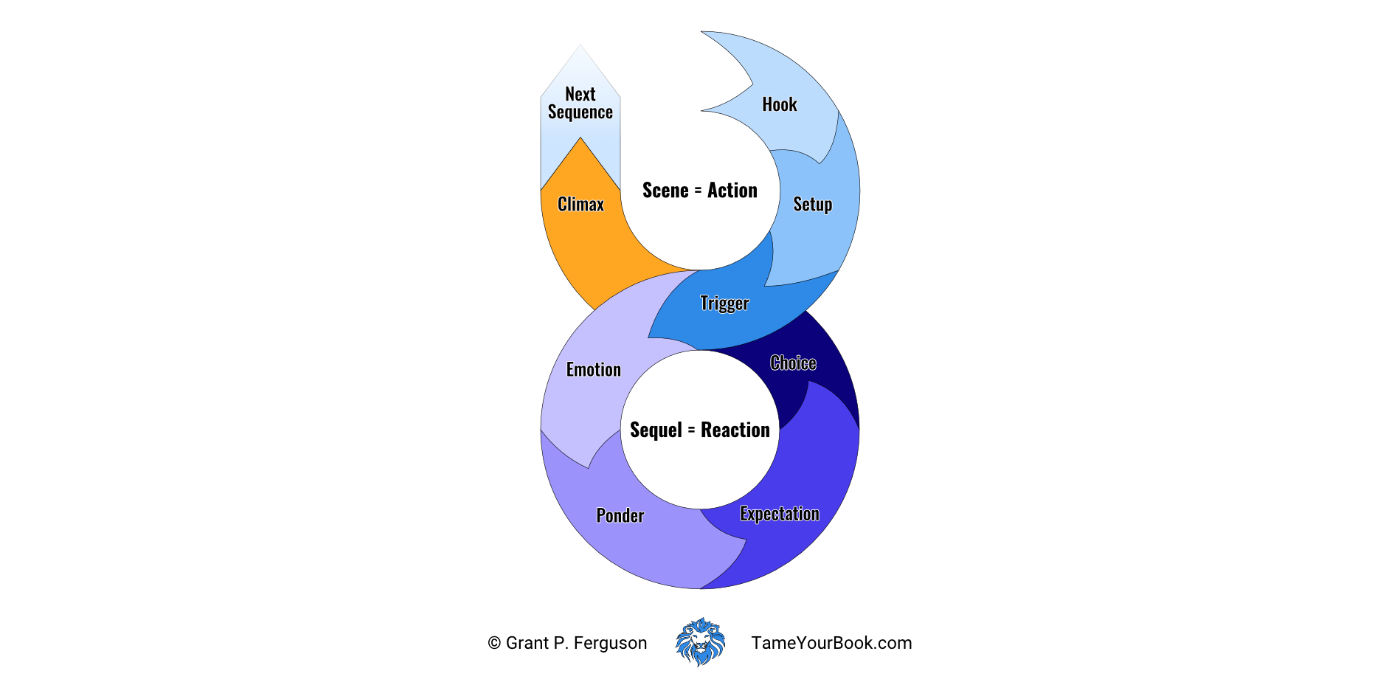
An internet search for “scene and sequel” will net you many definitions. Today’s post explains the 8-beats scene and sequel sequence.
By: Grant P. Ferguson
Last Updated: December 4, 2024
What Is the Scene and Sequel Sequence?
A scene and sequel sequence is an action followed by a reaction.
- The scene is a plot event where something happens.
- The sequel is the character’s emotional reaction to the event.
Show Action and Reaction in 1 or 2 Scenes
Because the term “scene” is used to describe the action event, writers may think the “sequel” is always a different scene.
However, as you read many novels, you’ll notice the “action” and “reaction” can and often appear within the same scene. There are no hard rules, so you choose whether the sequence occurs within one scene, or in separate action and reaction scenes.
Before you decide, read novels within your chosen genre to discover the style used most frequently by popular authors.
At the Macro Level
The “Scene” Part
The “scene” event shows an action that progresses the story’s plot, justifies a conflict (aka obstacle), denies the character’s achievement of a goal, and climaxes in a character’s action that sets up the next scene and sequel sequence.
The “Sequel” Part
The “sequel” shows how the character feels about the denied goal, conveying to readers the emotional reaction to the action event, shows the character pondering the outcome, sets an expectation of what the character could do next, and shows the character making a choice that sets up the outcome.
Why Is the Reaction in the Sequel Important?
The sequel bonds your character to the reader through emotions. Scan reviews of bestselling novels and you’ll find readers often buy a book for the plot but stay with a series because they love the characters and their emotions.
The sequel emphasizes what matters most to your readers — emotions!
At the Micro Level
At the micro-level, 8 beats comprise the scene and sequel sequence.
Scene (Action)
1. Hook: The hook snags readers’ interest.
- Shows action,
- Hints at trouble,
- Dialogue grabs attention, or
- Raises a question
2. Setup: Early information establishes the characters and location, and includes the setup for potential conflict (i.e., an obstacle to the protagonist achieving the scene’s goal).
3. Trigger: An event serves as the trigger that forces to the surface a conflict (aka an obstacle) that prevents the character from achieving the goal.
Sequel (Reaction)
4. Emotion: The character’s reaction to the event conveys emotion.
5. Ponder: The protagonist ponders those prior decisions and actions that led up to the event, and may include a dilemma comprising two choices that have different but equally unfavorable consequences.
6. Expectation: The character’s moment of reflection sets an expectation of what the individual could do to progress toward the scene’s goal.
7. Choice: The protagonist makes a tough choice to take action.
Scene (Action)
8. Climax: The character takes action, and the outcome sets up a new goal for the next scene and sequel sequence. For example, the scene:
- Ends with a cliffhanger,
- Redirects with a revelation,
- Presents a setback,
- Reveals a secret or a lie,
- Teases readers with a question, or
- Creates a plot twist.
Example: 8-Beat Scene and Sequel Sequence
- Hook: The story’s chief protagonist, Bob, hurries to a department meeting called by his boss, and if he gets there ahead of time, the new business he just signed with his largest customer could land him a promotion.
- Setup: To attend the impromptu meeting set by his boss, Bob must drive across town during rush hour.
- Trigger: Without warning, an accident occurs, denying Bob’s goal of arriving in time to have a private chat with his boss.
- Emotions: Shaken by the accident, Bob can’t quite comprehend what happened as a thunderstorm of rage swirls in his mind.
- Ponder: Bob ponders the event (e.g., who, what, where, when, why, how).
- Expectation: As his mind clears, Bob’s expectation of what to do builds as he concludes both drivers probably contributed to the unfortunate accident and calling the police could make matters worse.
- Choice: Because no one appears hurt and both cars are road worthy, Bob’s choice is to skip a call to the police and exchange contact information.
- Action: The drivers exchange information. Bob proceeds to the office without further delay, but just before he opens the door to the meeting already in progress, he wonders why the other driver seemed overly eager to avoid calling the police.
Put the Scene and Sequel Sequence to Work
The Trellis Method guides you to include the right content for every scene.

Way Forward
If you like to preplan your scenes, use the 8 beats to create simple outlines like the example above. Or if you prefer to free-write first, use the checklist to organize and enhance your scenes later. And if you want more details, check out this post: The Trellis Method: Give Readers What They Want Using Scene and Sequel Sequence.
Conclusion
The scene and sequel sequence creates a bond between your readers and characters, giving your audience the action and emotions they crave.
And if you want to know more about the Trellis Method, download the free mini course. You can learn more here.
Leave a Reply
How do you make sure your scenes include the actions and emotions designed to capture and hold your readers’ attention?


Leave a Reply