
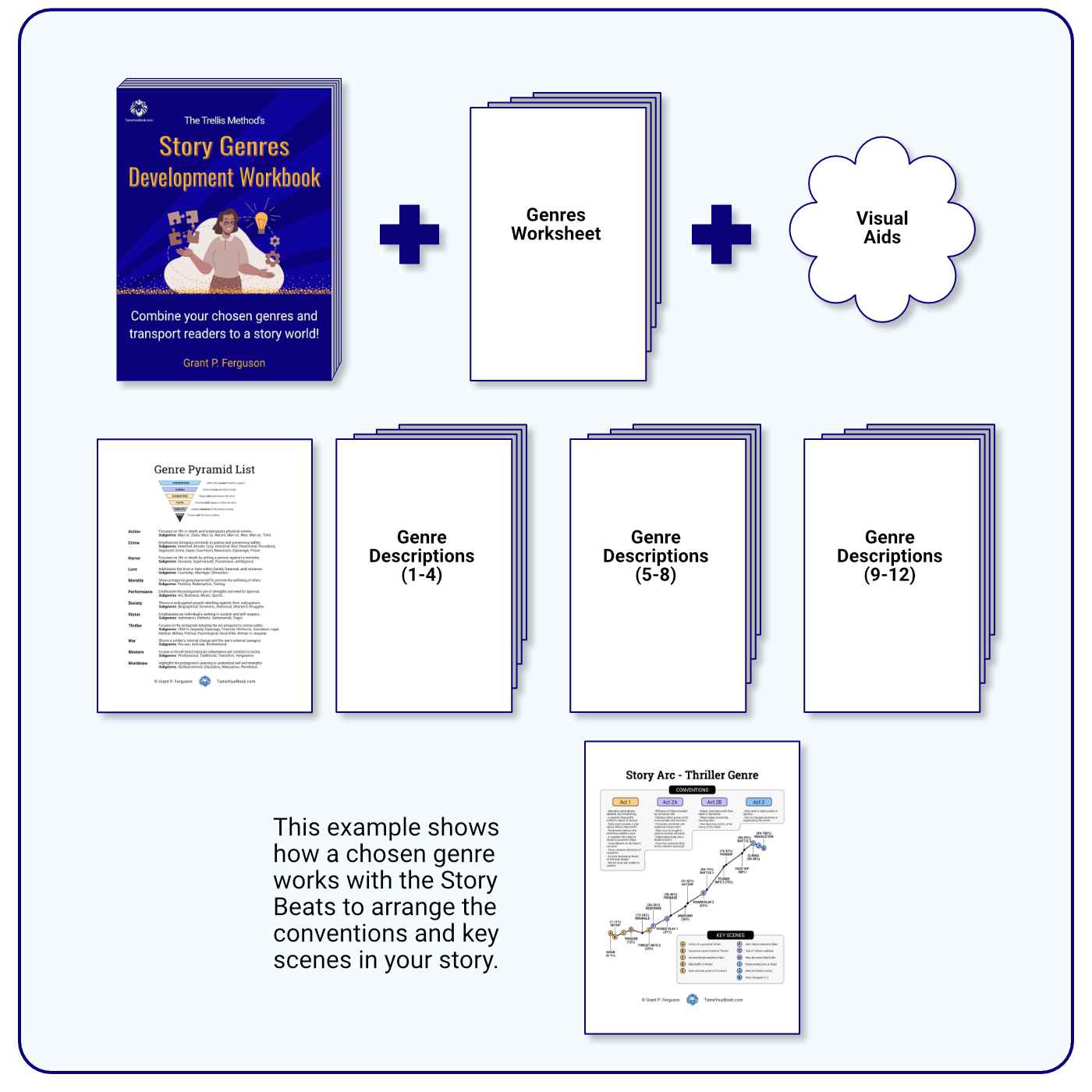
Genre is the secret sauce to writing better stories. Choose carefully because that sauce is how you can satisfy readers’ expectations.
By: Grant P. Ferguson
Last Updated: January 1, 2024
Choose carefully because that’s how you satisfy readers’ expectations. But which genre should you select? To clarify, let’s take a brief tour in this updated post and equip you with a dozen profiles to help you make informed choices.
💡 Read these posts for more about genres:
Fulfilling Genre Expectations Shows Respect for Your Audience
According to Robert McKee, author of Story:
“Story is about respect, not disdain, for the audience.”
In another chapter of Story, McKee stated:
“A beautifully told story is a symphonic unit in which structure, setting, character, genre, and idea meld seamlessly. To find their harmony, the writer must study the elements of story as if they were instruments of an orchestra — first separately, then in concert.”
To increase the story’s appeal to your audience, first, understand your chosen genre. Then combine all the story elements available to writers (e.g., characters, plots, themes, and structure).
Time-proven Genre Secrets
Here’s my take on understanding the story essentials that comprise each genre and drive audience expectations.

Choose Your Genre
The genre and subgenre categories are wide and deep. As a result, I’m serving up a taste on this topic, but like a snack, it will leave you wanting more. To enjoy a full meal, your reading and writing preferences help you select the primary genre before searching for subgenres and other details.
Therefore, I’ve listed popular genres and subgenres (click to download a copy) inspired by Robert McKee’s book Story*, Shawn Coyne’s book The Story Grid*, and several webpages at storygrid.com.

To clarify, you may have noticed the Fantasy Genre is absent from the list. In short, the editors at Story Grid suggest picking one of the main genres below and adding in the subgenre elements for your preferred form of fantasy.
Find More Genre Secrets in these Profiles
💡 Click a genre title to download its profile.
Note: Each genre profile shows its corresponding Story Grid web page.
Action
Focuses on life or death and emphasizes physical events. Subgenres: Man vs. State; People vs. Nature; One Individual vs. Another; Man vs. Time.
Crime
Emphasizes bringing criminals to justice and preserving safety. Subgenres: Detective, Murder, Cozy, Historical, Noir, Paranormal, Procedural, Organized Crime, Caper, Courtroom, Newsroom, Espionage, Prison.
Horror
Focuses on life or death by pitting a person against a monster. Subgenres: Uncanny, Supernatural, Possession, Ambiguous.
Love
Addresses the hate or love within family, fraternal, and romance. Subgenres: Courtship, Marriage, Obsession.
Morality
Shows the protagonist going beyond self to promote the well-being of others. Subgenres: Punitive, Redemption, Testing.
Performance
Emphasizes the protagonist’s use of strengths and need for approval. Subgenres: Art, Business, Music, Sports.
Society
Shows a subjugated people rebelling against their subjugators. Subgenres: Biographical, Domestic, Historical, Women’s Struggles.
Status
Emphasizes an individual’s ranking in society and self-respect.
Subgenres: Admiration, Pathetic, Sentimental, Tragic.
Thriller
Focuses on the protagonist defeating the evil antagonist to restore safety. Subgenres: Child in Jeopardy, Espionage, Financial, Hitchcock, Journalism, Legal, Medical, Military, Political, Psychological, Serial Killer, Woman in Jeopardy.
War
Emphasizes a soldier’s internal change and the war’s external savagery. Subgenres: Pro-war, Anti-war, Brotherhood.
Western
Focuses on the self-reliant individual’s independence and connection to society. Subgenres: Professional, Traditional, Transition, Vengeance.
Worldview
Highlights the protagonist’s yearning to understand self and strengths. Subgenres: Disillusionment, Education, Maturation, Revelation.
Please keep in mind each genre profile is just a “snack.” For example, that’s why you’ll need to…
Study Your Chosen Genre to Deliver What Readers Expect
In contrast to the absolutes in some disciplines, there is no single agreement on the definition of genres, subgenres, and tropes. For instance, to avoid information overload, start by studying what you like to read and write.
For example, I like mysteries and enjoy the intellectual challenge of solving a puzzle. With that in mind, here’s my example of breaking down the Crime Genre into the Murder Mystery subgenre, and reducing it further to the Cozy Mystery, which includes several well-established tropes.
Cozy Mystery
This subgenre focuses on preserving safety by bringing the killer to justice. Tropes: Animal*, Antique Store, Beach/Seaside, Bed-and-Breakfast, Campground, Contemporary, Craft/Hobby, Cruise Ship, Culinary, English Village, Farm, Historical, Humorous, Paranormal, Pet Store, Southern, Travel.
*Note: I love a good mystery where the sleuth’s cat or dog helps solve the puzzle.
Master Your Genre to Write Better Fiction
Here’s another McKee quote, reminding writers why we need to study genre.
“Each of us owes an enormous debt to the great story traditions. You must not only respect but master your genre and its conventions. Never assume that because you’ve seen films in your genre, you know it. This is like assuming you could compose a symphony because you have heard all nine of Beethoven’s. You must study the form. Books of genre criticism may help, but few are current and none is complete. Read everything, nonetheless, for we need all possible help from wherever we can get it. The most valuable insights, however, come from self-discovery; nothing ignites the imagination like the unearthing of buried treasure.”
Conclusion
Understanding your chosen genre helps you write better fiction while satisfying reader expectations. Your preferences guide your winding path of discovery, and like so much of writing, your chosen genre is a set of principles, not rules.
As McKee noted, no one has a monopoly on the comprehensive definition of a particular genre, so dig deep and enjoy the journey. Then blend what you learn and use the creative writing process to respect and satisfy your audience’s expectations.
Leave a Reply
What are your preferred genres, subgenres, and favorite books?
*As an Amazon Associate, I may earn a small commission from qualifying purchases, but it won’t cost you a penny more. Learn more in my Affiliate Disclaimer.


Leave a Reply